


Summary
The Model Context Protocol (MCP) is an open standard that enables AI applications to connect with external tools, data sources, APIs, databases, documents, and business systems through a standardised interface. It helps reduce the complexity of building individual integrations between AI applications and different enterprise systems. MCP is particularly valuable for AI integration services, enterprise AI, RAG applications, AI automation, and agentic AI development, where AI systems need access to real-time information and tools. This article explains how MCP works, its architecture, key components, benefits, security considerations, use cases, and differences from traditional APIs and RAG. It also explores how businesses can use MCP to build scalable, connected, and interoperable AI solutions.
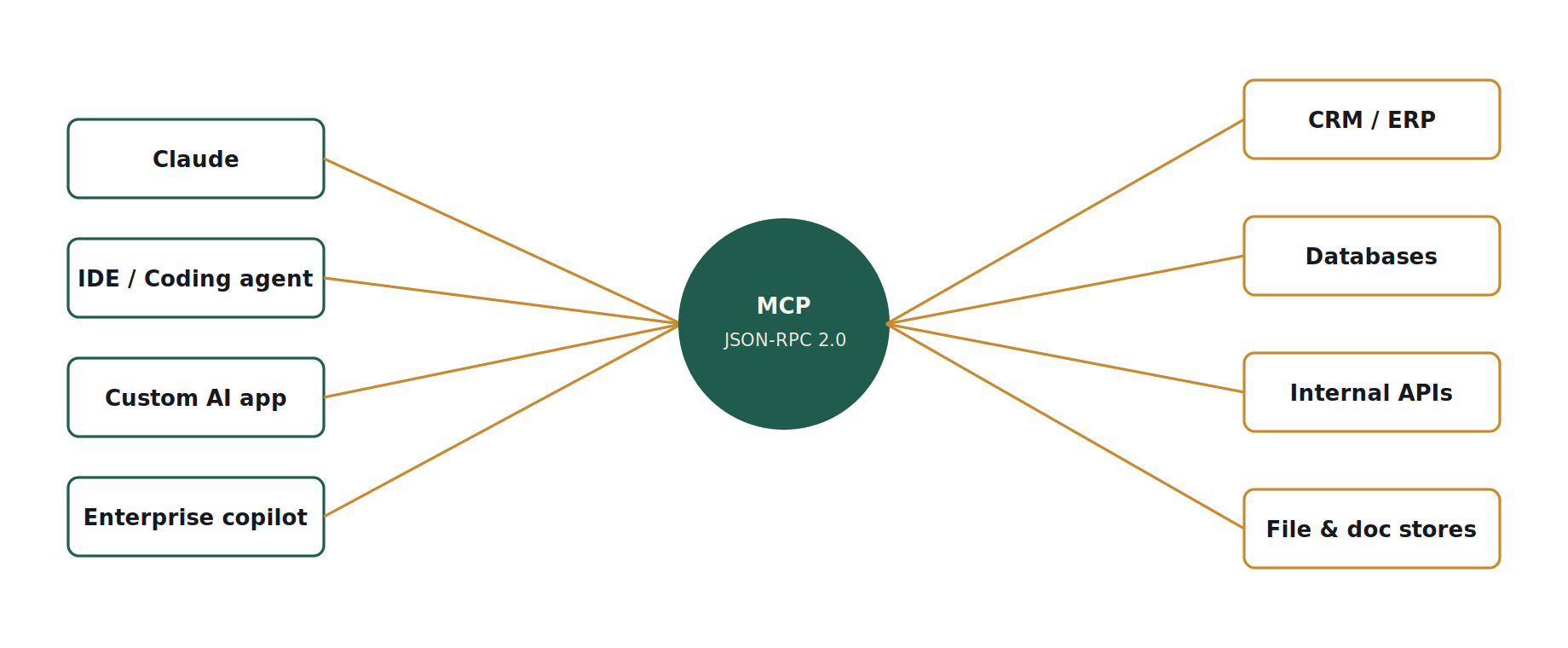
MCP standardizes the connection between any AI application and any external tool or data source.
Every enterprise racing to deploy AI agents eventually hits the same wall: a model is only as useful as the data and tools it can reach. For most of 2023 and 2024, connecting a large language model to a company’s databases, ticketing systems, and internal APIs meant hand-building the same plumbing again and again — once per model, once per tool, forever.
The Model Context Protocol (MCP) was built to end that cycle. Introduced by Anthropic in November 2024 as an open standard, MCP gives AI applications one consistent way to discover, call, and exchange data with external systems — the same way a single USB-C port replaced a drawer full of proprietary cables, as the protocol’s own documentation puts it. In under two years it has gone from a new Anthropic project to a vendor-neutral, Linux Foundation–governed standard adopted across the AI industry, from OpenAI’s ChatGPT to Google’s Gemini to Microsoft’s Copilot stack.
This guide walks through what MCP actually is, why it exists, how it works under the hood, what the data says about enterprise adoption, and how Carmatec helps organizations put it to work safely and quickly.
What is the Model Context Protocol?
MCP is an open-source, open standard for connecting AI applications to external systems — data sources, business tools, and development environments. Rather than writing a bespoke integration for every pairing of “AI model” and “tool,” developers build to one specification, and any MCP-compatible application can immediately use any MCP-compatible tool.
The protocol defines three roles that work together in every MCP interaction:
- Host — the AI-powered application the person actually uses: Claude, an IDE like VS Code or Cursor, or a company’s own custom agent.
- Client — a lightweight connector, embedded inside the host, that speaks the MCP protocol and manages one connection to one server.
- Server — a small program that exposes a specific system’s capabilities — a CRM, a codebase, a data warehouse, an internal API — in a structured, standardized way the model can understand.
Crucially, MCP is not a replacement for your APIs; it’s a layer that sits on top of them. Your Salesforce API, your internal REST endpoints, and your data warehouse connectors stay exactly as they are. What changes is that an AI model now has a uniform, self-describing way to discover what those systems can do and to call them safely, instead of a developer hard-coding a one-off integration for each combination.
You can read the original announcement directly from Anthropic’s Model Context Protocol launch post, or the living specification at modelcontextprotocol.io.
Why does this matter right now, specifically? Because the industry has quietly shifted from “can a model write good text” to “can a model reliably get work done.” That shift depends entirely on context and action — a model needs to see real, current data and be able to do something with it. MCP is the layer that makes that possible without every company reinventing its own private version of the same plumbing.
The integration bottleneck MCP was built to solve
Before MCP, connecting AI models to external systems was described inside Anthropic as the “M×N problem.” If a company used M different AI models or applications, and wanted them to reach N different tools and data sources, that meant building and maintaining M multiplied by N separate, custom integrations. Add a new model, and every existing tool integration has to be rebuilt for it. Add a new tool, and every model needs its own connector for it.
The result was predictable: fragile point-to-point connections, duplicated engineering work across teams, integrations that silently broke when an API changed, and AI initiatives that stayed stuck in pilot mode because scaling them meant scaling the integration debt right alongside them.
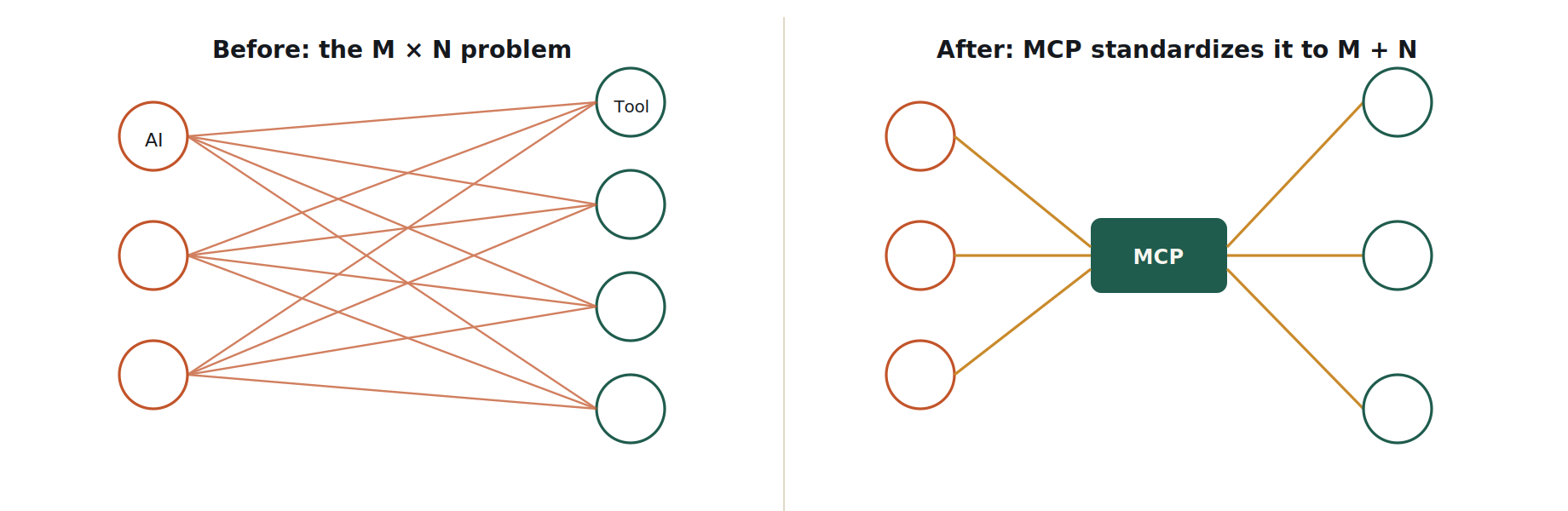
MCP replaces M × N bespoke integrations with one server per tool and one client per application.
With MCP, each tool provider builds one MCP server. Each AI application builds one MCP client. Any client can now talk to any server. The math changes from M×N to M+N — and every new tool or model added to the ecosystem makes every existing connection more valuable instead of adding more integration debt.
How MCP works, under the hood
MCP runs on JSON-RPC 2.0, a lightweight, well-established message format. Messages travel over one of two transports: stdio, used when a client and server run on the same machine (a common pattern for developer tools), or streamable HTTP, used when the server lives remotely — which is the pattern most enterprise deployments use, since the server sits behind the company’s own infrastructure and access controls.
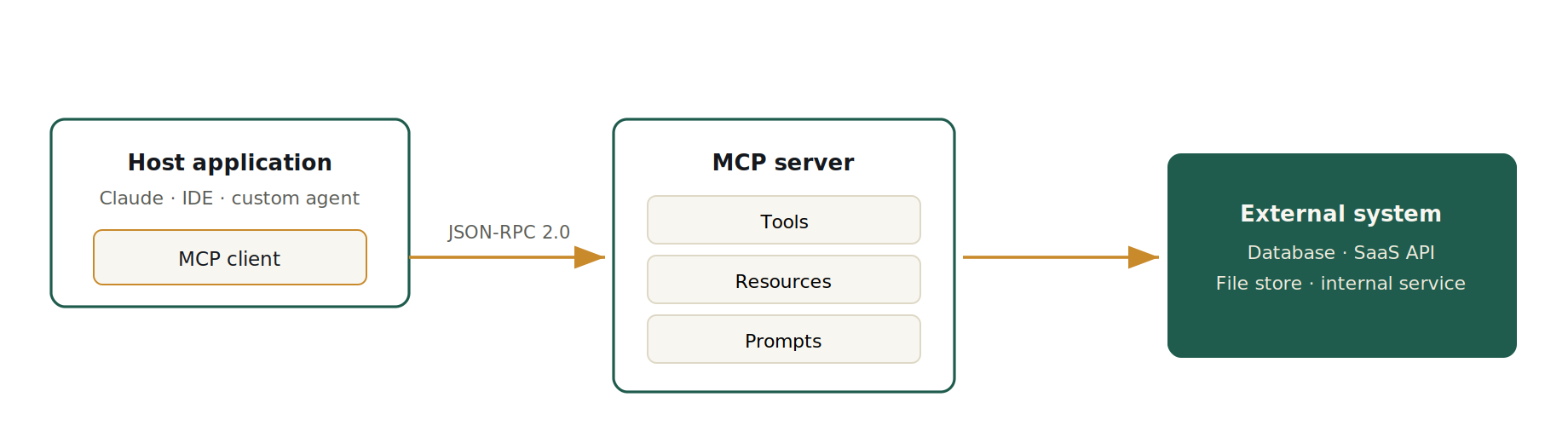
A host’s MCP client negotiates capabilities with a server, then calls its tools, resources, and prompts as needed.
A typical session follows a predictable lifecycle: the client and server first negotiate capabilities (what version of the protocol, what features are supported), the client then discovers what tools, resources, and prompts the server exposes, and finally the host’s model invokes those capabilities as needed, receiving structured, typed results back rather than a raw dump of text.
The protocol has matured quickly since 2024. A one-year update strengthened authorization, adding support for long-running, asynchronous operations and simplifying client registration through metadata URLs rather than requiring every user to be pre-registered with a central authorization server — changes covered in detail by SDxCentral’s report on the MCP anniversary update. On July 28, 2026, Anthropic, OpenAI, Google, Microsoft, and AWS jointly released the protocol’s largest specification update yet, with a twelve-month deprecation window for the previous version — a strong signal that the ecosystem is heading toward stabilization rather than fragmentation, as tracked in this 2026 MCP adoption analysis.
How MCP compares to the alternatives
MCP didn’t appear in a vacuum. Enterprises already had ways of connecting AI to data — it’s worth being clear about how MCP relates to them rather than treating it as a replacement for everything that came before.
MCP and Generative AI
Generative AI initially focused heavily on producing content.
However, modern AI applications are increasingly expected to interact with real-world systems.
For example, instead of simply answering:
“What is the status of my order?”
an AI agent could potentially retrieve the order information from a connected system and provide the latest status.
Similarly, an internal business assistant could retrieve information from company systems rather than relying only on static training data.
MCP can provide part of the infrastructure required for these connected AI experiences.
MCP and Agentic AI
Agentic AI systems are designed to perform multi-step tasks using reasoning, tools, and external information.
For example, an AI sales agent might:
- Identify a customer.
- Retrieve their CRM information.
- Review previous interactions.
- Analyse recent activity.
- Prepare a personalised recommendation.
- Update an approved CRM field.
Each step may require access to a different system.
MCP can provide a common interface through which AI applications can discover and use available tools and resources.
This makes MCP particularly relevant to agentic AI development.
MCP vs Traditional API Integrations
MCP does not replace APIs.
Instead, it can work alongside them.
| Feature | Traditional API Integration | MCP |
|---|---|---|
| Primary purpose | Application-to-application communication | AI application-to-tool/resource interaction |
| Interface | API-specific | Standardised protocol |
| AI discovery | Usually custom-built | Designed around AI interactions |
| Tool access | Developer-defined | Tools can be exposed through MCP |
| Reusability | Depends on implementation | Designed for standardised AI connectivity |
| Agentic workflows | Requires additional architecture | Well suited to tool-enabled AI agents |
APIs remain an important foundation for modern software systems. MCP can provide an additional layer for making approved capabilities available to AI applications.
MCP and RAG: Are They the Same?
No.
Retrieval-Augmented Generation (RAG) and Model Context Protocol (MCP) solve different problems.
RAG focuses on retrieving relevant information and providing it to an AI model as context.
MCP focuses on standardising how AI applications communicate with external resources and tools.
They can therefore work together.
For example:
User → AI Agent → MCP → Knowledge Source → Retrieved Information → AI Response
An organisation could use MCP to connect an AI application to a knowledge system while using RAG techniques to retrieve the most relevant content.
For businesses exploring RAG development services, understanding this distinction is important when designing AI architectures.
The three core primitives: tools, resources, prompts
Everything an MCP server exposes falls into one of three categories. Understanding them is the fastest way to understand what MCP actually lets an AI agent do.
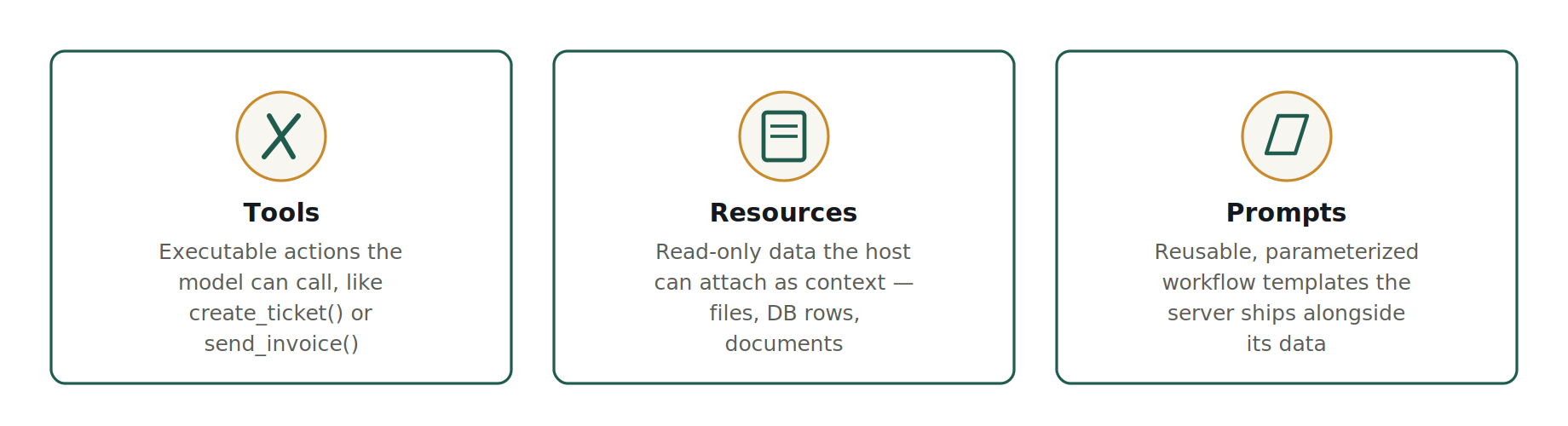
Tools act, resources inform, prompts standardize how a server’s best-practice workflows are used.
Tools are functions the model can decide to call — creating a record, running a query, sending a message, triggering a deployment. Resources are read-only content the host can pull in as context, from a single spreadsheet row to an entire knowledge base. Prompts are reusable, parameterized templates the server itself provides, so a team’s best-practice workflow for, say, triaging a support ticket, travels with the tool instead of living in someone’s personal prompt library.
Together, these three primitives are enough to describe almost any interaction a human employee has with a piece of software — which is exactly why MCP has scaled so quickly across such different categories of tools.
Key benefits of MCP for the enterprise
The technical elegance of MCP matters less than what it changes on a P&L and a roadmap. Here’s what shows up in practice:
Lower integration cost, less maintenance debt
Because a tool is integrated once and reused everywhere, teams stop rebuilding the same connector for every new AI initiative. Industry analysis from TechRT’s 2026 MCP server statistics report puts the reduction in API integration complexity for adopting companies at up to 40%, with DevOps teams in particular reporting 25–35% lower engineering overhead on integration work.
Faster time-to-market for AI features
When the connective layer is already standardized, product teams spend their time on the actual feature instead of the plumbing underneath it. The same TechRT research found enterprises using MCP shipping AI-powered features 20–30% faster than teams building point-to-point integrations from scratch.
Vendor neutrality, not lock-in
MCP is no longer solely an Anthropic project. In December 2025, Anthropic donated the protocol to the newly formed Agentic AI Foundation, a directed fund under the Linux Foundation co-founded with Block and OpenAI, and backed by Google, Microsoft, AWS, and Cloudflare — a governance structure detailed in this MCP adoption statistics analysis. Building on an open, multi-vendor standard means an enterprise’s integration investment isn’t tied to a single AI vendor’s roadmap.
Build once, reach every major AI product
An MCP server built for one purpose works across the ecosystem: Claude, ChatGPT, Gemini, Microsoft Copilot, VS Code, and dozens of coding assistants can all speak to it, as documented by Digital Applied’s verified 2026 MCP adoption statistics.
Auditability that regulated industries actually need
Every tool call is a structured, logged, inspectable request-response pair rather than an opaque instruction buried inside a prompt — a meaningful difference for compliance and audit teams in finance and healthcare.
Better-grounded answers, fewer hallucinations
A model answering from memory alone will confidently guess at a customer’s account balance or a shipment’s status if it doesn’t actually know. A model with an MCP-connected tool can look the answer up instead. Grounding responses in live, structured data is one of the most direct ways enterprises reduce the hallucination risk that keeps AI initiatives stuck in pilot mode.
“MCP is not a feature — it is infrastructure.” The organizations treating it that way in 2026 are the ones scaling agentic AI past the pilot stage.
MCP by the numbers
MCP’s growth curve is one of the steepest of any recent developer standard. Monthly downloads of the official Python and TypeScript SDKs grew from roughly 100,000 in the month of launch to more than 97 million by March 2026 — a nearly 970x increase in eighteen months, according to data compiled in this state of enterprise MCP adoption report.
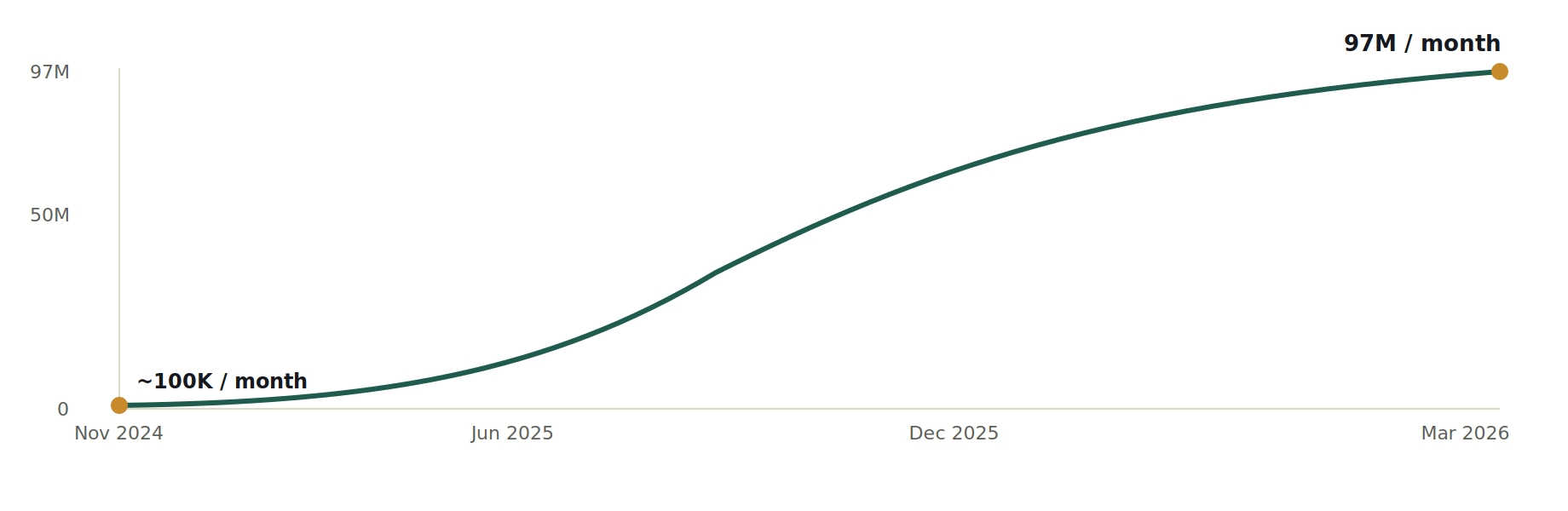
MCP SDK downloads, November 2024 launch to March 2026. Source: cybertizeweb.com State of Enterprise MCP Adoption 2026.
| 10,000+
active public MCP servers as of Anthropic’s December 2025 ecosystem update. |
$1.8B
projected 2025 market size for MCP-driven connectivity, led by healthcare, finance, and manufacturing. |
41%
of surveyed software organizations report limited or broad MCP production use in 2026. |
Enterprise buy-in is accelerating too: Forrester projects that 30% of enterprise application vendors will ship their own MCP server in 2026, effectively making MCP support table stakes for enterprise SaaS. At the same time, the honest picture is one of real but uneven maturity — only an estimated 8.5% of public MCP servers currently implement the protocol’s mandatory OAuth 2.1 authorization standard, a gap that underscores why professional implementation and governance matter as much as the integration itself, per the same cybertizeweb research cited above.
It’s worth noting that MCP statistics vary meaningfully between sources, and some widely circulated figures — like a once-popular claim that 78% of enterprise AI teams run MCP in production — have since been walked back by the analysts who first published them, as flagged transparently in Digital Applied’s source-verified 2026 statistics review. The figures used in this article are drawn from primary vendor data and named survey research wherever possible, and should still be read as directional rather than exact.
Real-world MCP use cases across industries
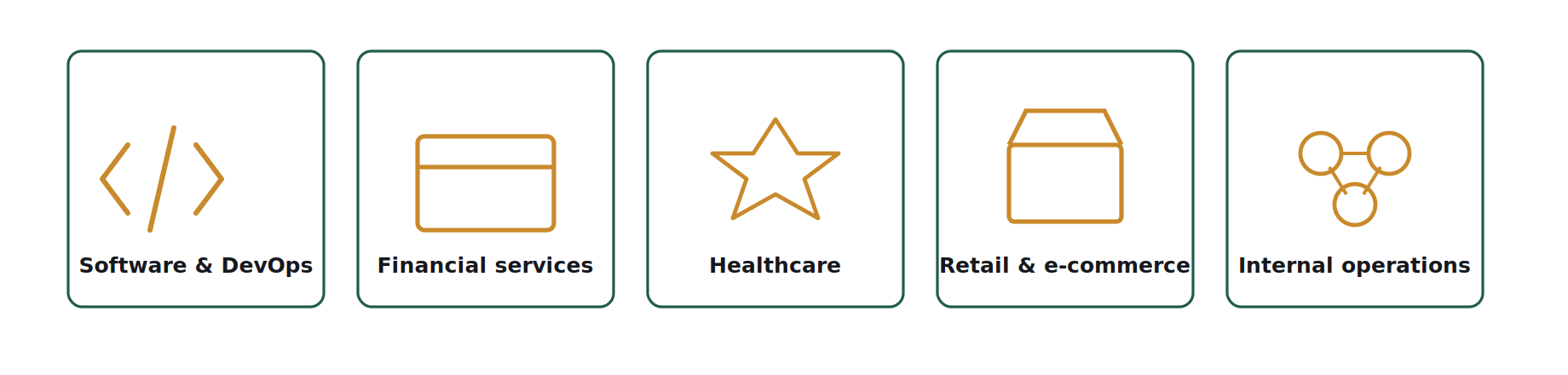
MCP adoption is strongest in industries where secure, structured access to live data is business-critical.
Software engineering & DevOps is MCP’s deepest and most mature use case today. Coding assistants like Claude Code, Cursor, and VS Code use MCP to read repositories, run tests, check CI status, and open pull requests with full project context, rather than working from a static code snippet pasted into a chat window.
Financial services teams connect agents to transaction systems, risk models, and compliance databases under strict, scoped access controls — letting an analyst ask a natural-language question and get an answer sourced from live, governed data instead of a stale export.
Healthcare organizations are early adopters of MCP for retrieving records from EHRs, checking scheduling systems, and surfacing clinical guidelines, almost always with a human reviewer in the loop given the sensitivity of the data involved.
Retail and e-commerce businesses use MCP-connected agents to monitor inventory, adjust pricing, and manage orders in response to real-time demand signals across channels.
Internal operations teams connect Slack, Notion, Jira, and Google Drive through MCP so that a single company-wide assistant can answer questions and take action across tools employees already use every day.
Manufacturing operations are beginning to connect agents to MES and SCADA data, letting a supervisor ask plain-language questions about line performance or predictive-maintenance flags instead of navigating a specialist dashboard. Education and workforce training platforms use MCP to let AI tutors pull a learner’s real progress data and course materials, personalizing instruction instead of guessing at context.
Regional and sector data from TechRT’s MCP server statistics confirms adoption is strongest precisely in finance, healthcare, and e-commerce — the industries where secure, structured data access carries the most business weight — while North America currently accounts for an estimated 40–45% of global MCP deployments, with Asia-Pacific, including India, cited as the fastest-growing region.
Security, governance, and what to plan for
MCP’s speed of adoption has outpaced its security maturity in places, and enterprises evaluating it should go in clear-eyed. Tool overexposure — connecting a model to far more tools than a given task needs — widens the attack surface and can confuse a model’s tool-selection logic. Context window limits mean a server has to be designed thoughtfully, returning focused, relevant data rather than dumping entire databases into a conversation. And authorization is still catching up: as noted earlier, only a small share of public servers currently implement the protocol’s OAuth 2.1 standard in full.
The gap between ambition and readiness shows up clearly in survey data. Cisco’s AI Readiness Index found that 83% of businesses plan to roll out agentic AI, but only 24% currently have live tracking and guardrails in place to govern it safely — a gap summarized in this state of enterprise MCP and AI agent governance report. As one security lead put it in coverage of MCP’s one-year update, the clear lesson from MCP’s first year is to pair it with strong identity management, role-based access control, and observability from day one, not retrofit them after something goes wrong.
There’s also an organizational dimension to governance, not just a technical one. Deciding which teams are allowed to publish an MCP server, which servers a given department’s agents are allowed to connect to, and who reviews a new tool before it goes live are policy questions as much as engineering ones. Enterprises that treat MCP purely as a developer tool tend to end up with dozens of shadow servers and no consistent picture of what data their AI agents can actually reach — precisely the kind of sprawl that regulators and security teams flag first.
None of this is a reason to wait. It’s a reason to bring in a partner who treats identity, access control, and monitoring as part of the architecture from the first design conversation — not as a follow-up project.
A practical path to adopting MCP
Enterprises that get value from MCP quickly tend to follow a similar sequence, rather than trying to connect everything at once:
- Start with one high-leverage use case. Pick a workflow with a clear owner and a measurable outcome — resolving support tickets faster, cutting a manual reporting task — rather than building MCP servers as a general-purpose exercise.
- Check what already exists. With more than 10,000 public MCP servers already available, many common systems — GitHub, Slack, Google Drive, popular CRMs — already have a server a team can adopt or fork rather than building from zero.
- Design the authorization layer first. Decide identity, scopes, and role-based access before writing the first tool, not after a pilot is already in production. Retrofitting authentication is measurably harder than building it in from the start.
- Pilot with monitoring in place. Log every tool call from day one, so a small pilot generates the audit trail a security team will eventually ask for anyway.
- Scale deliberately. Add tools and servers as real use cases justify them, keeping each agent’s available toolset narrow and purposeful rather than exposing everything to every agent by default.
How MCP Can Support Enterprise AI Strategy
For enterprises, AI adoption is moving from experimentation toward integration with real business processes.
A scalable AI strategy therefore needs more than a language model.
It may require:
- AI models
- Data infrastructure
- APIs
- Security controls
- Knowledge systems
- Automation frameworks
- AI agents
- Integration layers
MCP can become one component within this broader architecture by providing a standardised way for AI applications to interact with tools and resources.
Why enterprises choose Carmatec for MCP?
Understanding MCP is one thing. Designing servers around your actual systems, wiring in the right access controls, and keeping it running as your AI footprint grows is another. Our MCP integration services can support organizations looking to connect AI applications with enterprise tools, APIs, databases, knowledge systems, and business workflows.
▸ Two decades of enterprise delivery
Carmatec has designed and supported digital platforms — software engineering, cloud infrastructure, and AI-led modernization — since 2003, across global markets including the US, India, and Qatar.
▸ End-to-end MCP lifecycle
From auditing your existing systems and designing server and client architecture, to secure development, deployment, and ongoing optimization — Carmatec manages the full lifecycle so nothing is left half-built.
▸ Governance built in, not bolted on
Identity management, role-based access control, and observability are part of the initial architecture, directly addressing the security gaps slowing down MCP adoption industry-wide.
▸ AI agents and copilots that use it well
Carmatec’s existing AI agent and copilot development practice means the MCP servers we build plug directly into the assistants your teams will actually use — not a disconnected proof of concept.
▸ Cross-industry experience
From BFSI and healthcare to retail and supply chain, Carmatec brings sector-specific context to how an MCP server should expose data — and what it should never expose.
▸ Global delivery, without the overhead
A distributed team across the US, India, and Qatar gives clients cost-effective delivery and extended coverage, without sacrificing the quality of a specialist team.
Talk to Carmatec about MCP implementation →
The Future of MCP
As AI systems become more capable, the ability to interact with external tools and information will become increasingly important.
The future of enterprise AI is unlikely to consist solely of chatbots that generate text. Organisations are increasingly exploring AI assistants and agents capable of retrieving information, coordinating workflows, and executing approved actions.
In this environment, interoperability becomes essential.
Standards such as MCP can help create a more consistent ecosystem in which AI applications can communicate with external tools and resources.
This could contribute to more modular AI architectures where organisations can change models, add tools, and expand workflows without rebuilding every integration from scratch.
MCP isn’t optional anymore — it’s infrastructure
Two years ago, connecting an AI model to a company’s real systems was a custom engineering project every single time. Today, it’s a standard with a governance body, a rapidly growing ecosystem of over 10,000 public servers, and support from every major AI vendor. The organizations getting real value from agentic AI in 2026 are the ones that stopped treating integration as a one-off cost and started treating it as infrastructure worth building properly, once.
Whether you’re evaluating MCP for the first time or already have pilots running and need to take them to production safely, Carmatec can help design, build, and govern the MCP layer that lets your AI initiatives scale past the proof-of-concept stage.
Explore Carmatec’s AI Agent Development Services →
Frequently Asked Questions
What is the Model Context Protocol (MCP)?
The Model Context Protocol (MCP) is an open standard that enables AI applications to connect with external tools, data sources, resources, and services through a standardised interface.
Is MCP an AI model?
No. MCP is a protocol, not an AI model. It provides a communication framework that allows AI applications to interact with external systems.
Does MCP replace APIs?
No. APIs continue to provide application-to-application communication. MCP can work with APIs by exposing approved API capabilities to AI applications in a standardised way.
Is MCP useful for agentic AI?
Yes. Agentic AI applications often need access to external tools and information to complete multi-step tasks. MCP can provide a standard mechanism for exposing those capabilities.
What is the difference between MCP and RAG?
RAG focuses on retrieving relevant information for an AI model, while MCP focuses on standardising communication between AI applications and external tools or resources. They can be used together.
Can MCP be used for enterprise applications?
Yes. MCP can be used as part of enterprise AI architectures connecting AI applications with approved databases, APIs, documents, SaaS applications, and business systems.
Is MCP secure?
Security depends on the implementation. Organisations should apply appropriate authentication, authorisation, least-privilege access, input validation, monitoring, and approval controls when exposing tools to AI systems.