
In a world that is so dynamic, by 2026 workforce management (WFM) has moved beyond the traditional into an essential strategic imperative for businesses to succeed amidst rapid digital change, hybrid work models and global talent pools. With AI, machine learning and predictive analytics leading the way, today’s WFM solutions go beyond simply scheduling shifts or monitoring hours—they’re about enabling agility, policing compliance, increasing employee satisfaction and delivering measurable business results. Citing recent industry analysis, Savings companies that use sophisticated WFM solutions are up to 30% lower on labor costs and achieve productivity gains of as much as 20%.
Over the last 20 years, Carmatec’s expertise in custom software development, mobile apps & web solutions and ERP integration services has helped us couple with numerous organizations for implementing and leveraging these systems. Whether it’s a start-up that is scaling their operations or an enterprise with thousands of remote workers, our custom deployments allow for easy adoption and the highest ROI. This comprehensive blog post breaks down the 20 top WFM software and tools that will define workforce management in 2026, gathered from hundreds of user-verified reviews on platforms like G2 and Capterra and ruminates over integration options, scalability opportunities, hot trends like AI-fueled forecasting. We’ve organized it with in-depth reviews, comparisons and practical tips to aid your decision-making process.
The Importance of Workforce Management in 2026
The Rise of AI and Automation
By automating such routine tasks as shift allocations and overtime predictions, AI is changing WFM, leaving HR teams available to play a more strategic role. Tools these days include natural language processing for easy questions and sentiment analysis to get a sense of the mood among employees.
Hybrid and Global Challenges
And with 58% of the workforce hybrid (according to Gartner), tools need to make way for ideas such as geofencing, multi-timezone scheduling, and cross-border legal compliance. Sustainability features, such as carbon footprint tracking for travel, are gaining momentum too.
Key Benefits for Businesses
- Cost Saving: Improved staff scheduling and reduced over-staffing by 15-25%.
- Employee Motivation: Your employees can now deliver better guest service as 40% is cut in administrative questions.
- Compliance Assurance: Automated audits keep your bank balance in check in the time of changing labor laws.
Top Picks: The 20 Best WFM Tools of 2026
We’ve categorized our selections into tiers for easier navigation: Best for SMBs, Best for Enterprises, y Best for Niche Needs. Each review covers core features, pros/cons, pricing, and ideal use cases.
1. Goalz Work: Workforce Management & Performance Alignment Tool

Goalz Work specializes in streamlining workforce management by aligning company objectives with employee performance. In 2026, its AI-powered workforce planning and predictive performance insights help organizations optimize staffing, track productivity, and keep teams engaged — all while integrating with tools like Slack, Teams, and HRIS platforms.
Características clave:
- Employee Scheduling
- Time and Attendance Tracking
- Gestión de salidas
- Shift Swapping
- Payroll Integration
- Análisis en tiempo real
Pros: Simplifies workforce planning; boosts team accountability and engagement.
Contras: Requires initial setup effort for best results.
Precios: custom Enterprise solutions. Free trial included.
Ideal para: HR teams and managers seeking smarter workforce planning and real-time performance visibility.
2. Deel: Global Payroll and Compliance Powerhouse

Deel remains a frontrunner for distributed teams, handling EOR services, contractor payments, and equity management across 150+ countries. In 2026, its AI-powered contract generator and real-time compliance alerts stand out, integrating effortlessly with tools like Slack and Xero.
Características clave:
- Automated global payroll in 120+ currencies.
- Onboarding workflows with e-signatures.
- Expense tracking and reimbursements via mobile app.
Pros: Lightning-fast setup for international hires; 24/7 support in local languages.
Contras: Advanced analytics require higher tiers; no standalone time clock.
Precios: $29/user/month (Core); $49/user/month (Pro); custom for Enterprise. Free demo.
Ideal para: Tech startups expanding globally.
3. Rippling: All-in-One HR and IT Hub

Rippling’s unified platform merges WFM with IT management, automating device provisioning alongside scheduling. 2026 updates include AI-driven anomaly detection in time logs and policy enforcement via chatbots.
Características clave:
- Drag-and-drop scheduling with demand forecasting.
- Unified payroll and benefits administration.
- 600+ integrations, including Okta and Microsoft Teams.
Pros: Reduces tool sprawl; excellent for tech-savvy teams.
Contras: Steep initial learning curve for non-tech users.
Precios: $8/user/month (Essentials); scales to $20+ for advanced features. Annual billing.
Ideal para: Growing SMBs with remote IT needs.
4. Homebase: Shift Scheduling for Hourly Teams

Tailored for retail and hospitality, Homebase’s 2026 iteration features predictive staffing based on sales data and weather APIs, plus geofenced clock-ins to curb buddy punching.
Características clave:
- Open shift templates and auto-approvals.
- Team messaging and announcements.
- Basic payroll sync with Gusto.
Pros: Intuitive mobile app; free tier covers essentials.
Contras: Limited custom reporting; add-ons inflate costs.
Precios: Free (Basic); $20/location/month (Essentials); $39 (Plus). 14-day trial.
Ideal para: Restaurants and small retail chains.
5. Agendrix: Simple, Bilingual Scheduling

This Canadian gem excels in multi-location ops with drag-and-drop calendars and automated shift reminders. 2026 enhancements add voice-activated time entries for hands-free use.
Características clave:
- Availability-based scheduling.
- Time-off calendars with conflict alerts.
- Exportable reports for payroll.
Pros: Affordable and user-friendly; strong for bilingual teams.
Contras: Fewer global integrations than competitors.
Precios: $2.95/user/month; 21-day free trial.
Ideal para: SMBs in North America with shift workers.
6. Connecteam: Mobile-First for Frontline Workers

Connecteam’s all-in-one app shines for non-desk employees, offering checklists, GPS routing, and knowledge bases. AI in 2026 suggests training paths based on performance gaps.
Características clave:
- Custom forms and inspections.
- Chat and file sharing.
- Offline mode for remote sites.
Pros: High adoption rates; unlimited free users.
Contras: Web dashboard lags behind mobile.
Precios: Free (Basic); $29/month (Premium) for 30 users. 14-day trial.
Ideal para: Field services and construction firms.
7. BambooHR: HR-Centric with WFM Add-Ons

BambooHR focuses on people management, with 2026 AI tools for resume parsing and engagement surveys. Its time tracking module integrates seamlessly for holistic HR.
Características clave:
- Performance review workflows.
- E-learning and onboarding.
- API para integraciones personalizadas.
Pros: Clean, scalable interface; great for culture-building.
Contras: Full WFM requires extras.
Precios: $6/user/month base; add-ons from $2/user. 14-day trial.
Ideal para: SMBs prioritizing employee experience.
8. Gusto: Payroll-First with Scheduling

Gusto’s simplicity appeals to solopreneurs and small teams, with 2026 tax AI handling multi-state filings. Scheduling is lightweight but effective for basics.
Características clave:
- Automated tax compliance.
- Contractor payments.
- Time-off tracking.
Pros: Quick setup; bundled benefits.
Contras: Lacks advanced forecasting.
Precios: $40/month base + $6/user; free trial.
Ideal para: Freelance-heavy startups.
9. When I Work: Real-Time Shift Management

Focused on flexibility, this tool’s 2026 AI predicts no-shows and suggests covers, with broadcast messaging for instant updates.
Características clave:
- Shift trade marketplace.
- Labor cost forecasting.
- Mobile notifications.
Pros: Fast and collaborative.
Contras: Basic analytics.
Precios: $2/user/month; free trial.
Ideal para: Retail with variable shifts.
10. ADP Workforce Now: Scalable HR Automation

ADP’s robust suite handles massive payrolls with AI-driven insights into turnover trends. 2026 sees enhanced mobile self-service for global workforces.
Características clave:
- Absence management with accruals.
- Compliance reporting.
- Talent acquisition integration.
Pros: Proven reliability; HIPAA-compliant.
Contras: Customization needs experts.
Precios: Custom; starts ~$62/month.
Ideal para: Mid-to-large corps in regulated industries.
11. UKG Pro: AI-Powered Enterprise Optimization

UKG’s platform uses machine learning for dynamic scheduling, reducing understaffing by 25%. 2026 features include VR training simulations.
Características clave:
- Predictive workforce planning.
- Multi-country payroll.
- Employee wellness tracking.
Pros: Deep customization; strong ROI metrics.
Contras: High implementation time.
Precios: $27/employee/month base; custom.
Ideal para: Global enterprises.
12. Workday HCM: Cloud-Native Insights

Workday’s adaptive architecture excels in skills-based rostering, with 2026 blockchain for secure credential verification.
Características clave:
- Real-time dashboards.
- Learning management.
- Advanced forecasting.
Pros: Intuitive analytics; scalable.
Contras: Premium pricing.
Precios: Custom; ~$99/user/month.
Ideal para: Tech-forward enterprises.
13. Paycom: Self-Service Revolution

Paycom’s Beti app empowers employees to manage everything from shifts to pay stubs, cutting HR tickets by 60% in 2026.
Características clave:
- Automated approvals.
- Expense automation.
- Reporting suite.
Pros: Employee-centric; mobile-first.
Contras: Less flexible for custom needs.
Precios: Custom; ~$50–$100/user/month.
Ideal para: Large orgs focused on efficiency.
14. Paylocity: Engaging Performance Tools

With gamification and AI coaching, Paylocity boosts retention. 2026 adds sentiment analysis from feedback loops.
Características clave:
- Goal tracking.
- Benefits enrollment.
- Scheduling optimizer.
Pros: Fun interface; strong support.
Contras: Overkill for small teams.
Precios: Custom; starts ~$20/user/month.
Ideal para: Mid-market with high turnover.
15. Ceridian Dayforce: Unified HCM Suite

Dayforce’s single database eliminates data silos, with 2026 AI for real-time pay adjustments.
Características clave:
- Scheduling with fatigue monitoring.
- Global compliance.
- Analytics hub.
Pros: Comprehensive; fast processing.
Contras: Enterprise-only focus.
Precios: Custom; ~$15–$30/user/month.
Ideal para: Multinational firms.
Best for Niche Needs
16. RemoFirst: Global EOR Specialist

For hands-off international expansion, RemoFirst manages full employment lifecycles in 160+ countries.
Características clave:
- Visa and relocation support.
- Local payroll expertise.
- Compliance dashboards.
Pros: Hassle-free scaling.
Contras: Limited domestic features.
Precios: $25–$199/user/month. Demo available.
Ideal para: Companies entering new markets.
17. Sloneek: European SMB Focus

Sloneek’s GDPR-compliant tools include biometric attendance, perfect for EU ops.
Características clave:
- Shift bidding.
- Performance modules.
- Mobile clock-ins.
Pros: Cost-effective; intuitive.
Contras: English support improving.
Precios: €2.50/user/month; trial.
Ideal para: EU-based SMBs.
18. NICE: Contact Center Excellence

NICE’s WFM optimizes agent schedules with speech analytics for 2026.
Características clave:
- Intraday management.
- Adherence scoring.
- Multichannel forecasting.
Pros: Industry-leading accuracy.
Contras: Niche applicability.
Precios: Custom; ~$100/agent/month.
Ideal para: Call centers.
19. monday.com: Customizable Workflows

Adapt monday.com’s boards for WFM with automations for resource allocation.
Características clave:
- Visual timelines.
- Collaboration tools.
- Integration marketplace.
Pros: Flexible; no-code setup.
Contras: Requires configuration.
Precios: Free (2 users); $9/seat/month.
Ideal para: Project-based teams.
20. Anaplan: Strategic Planning

Anaplan’s modeling forecasts workforce needs with scenario planning.
Características clave:
- Connected planning.
- Real-time collaboration.
- What-if analysis.
Pros: Forward-looking insights.
Contras: Steep curve.
Precios: Custom enterprise.
Ideal para: Finance-driven HR.
21 . Time Champ
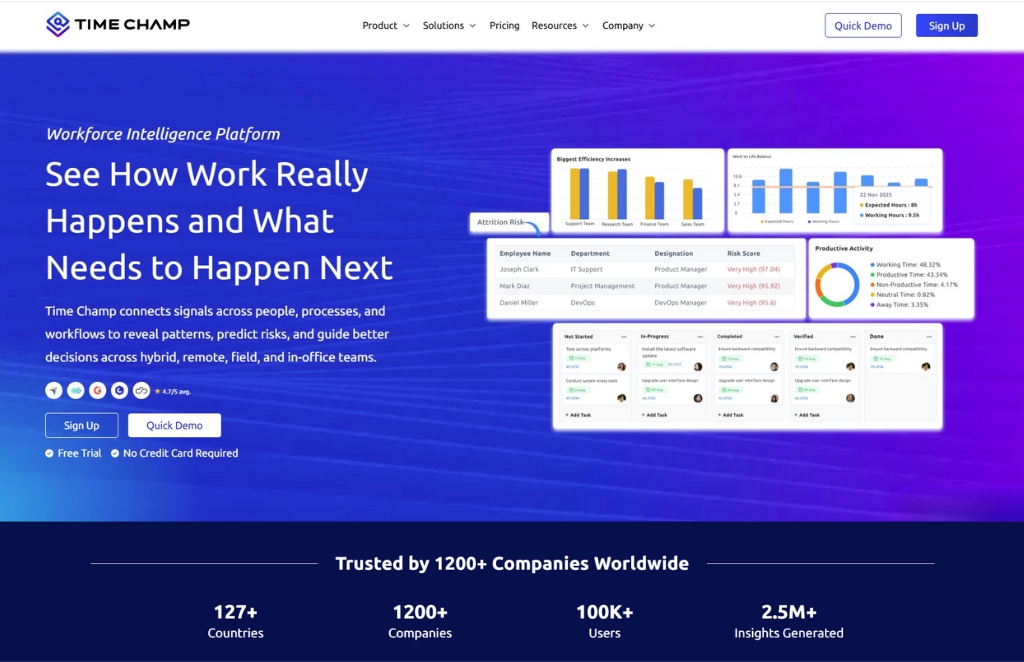
Time Champ es un workforce intelligence platform that delivers deep visibility into employee productivity, time utilization, and work patterns. It goes beyond basic time tracking by using AI-driven insights to help organizations optimize performance across on-site, remote, and hybrid teams. Recent updates emphasize predictive productivity trends, anomaly detection in work behavior, and real-time workforce analytics.
Características clave:
- Automatic time tracking with app, website, and task-level intelligence.
- Real-time dashboards displaying attendance, idle time, and workload distribution.
- Workforce monitoring with screenshots, activity timelines, and configurable privacy controls.
- Custom reports for performance analysis, compliance, and workforce optimization.
Pros: Powerful workforce insights; strong analytics for managing remote and distributed teams.
Contras: Advanced monitoring capabilities may require clear communication and policy alignment.
Precios: $3.9/user/month (Basic). 7-day free trail.
Ideal para: Businesses looking for a workforce intelligence platform to improve productivity, gain actionable insights, and manage distributed teams effectively.
22 . Truein

Truein is an AI-powered facial recognition attendance software designed for hourly and multi-site workforce management. It enables organizations to accurately track employee attendance, shifts, leaves, and work hours using advanced facial recognition combined with geofencing technology.
Truein runs seamlessly on mobile/tablets. Its offline attendance capability enables employees to mark attendance even without an internet connection, with data automatically syncing once connectivity is restored. Truein enables real-time attendance tracking across multiple locations and shifts, ensuring high accuracy, regulatory compliance, and payroll-ready reporting.
Características clave:
AI-powered face recognition attendance that works even with masks or glasses
GPS geofencing to restrict clock-ins from unapproved sites
Seamless integration with payroll and HRMS solutions
Pros: Prevents buddy-punching and time theft, reducing revenue leakages
Contras: Not suited for desk-based employees
Precios: Starts at $3/user/month, billed annually
Ideal for: Companies managing workers across multiple locations like construction, facility management firms
Comparative Analysis: Choosing the Right Tool
Feature Comparison Table
Pricing Tiers Breakdown
- Budget (<$5/user): Homebase, When I Work—great starters.
- Mid-Range ($5–$20/user): Rippling, BambooHR—balanced value.
- Premium (>$20/user): UKG Pro, Workday—enterprise depth.
Integration and Scalability Insights
Top tools like Rippling and ADP boast 500+ connectors, ensuring compatibility with CRMs like Salesforce. For scalability, enterprise picks handle 10,000+ users without performance dips.
Emerging Trends in WFM for 2026
AI and Predictive Analytics
Expect tools to evolve with generative AI for natural scheduling queries, like “Optimize shifts for Q4 holidays.”
Sustainability and DEI Integration
New modules track diverse hiring metrics and eco-friendly remote policies.
Voice and AR Enhancements
Voice assistants for time entries and AR for virtual training are on the rise.
How Carmatec Can Transform Your WFM Implementation
At Carmatec, we don’t just recommend tools—we build ecosystems around them. Our services include:
- Custom Integrations: Seamlessly link WFM with your ERP or CRM.
- AI Enhancements: Develop bespoke predictive models.
- Desarrollo de aplicaciones móviles: Tailor apps for your workforce.
- Consultoría y formación: Ensure 95% adoption rates.
We’ve helped clients reduce implementation time by 40% and boost efficiency. Ready to upgrade? Contact Carmatec for a free audit.
Conclusion: Empower Your Workforce Today
The 2026 WFM landscape offers unparalleled opportunities for innovation, but the key is alignment with your unique challenges. Whether you’re drawn to Deel’s global prowess or Connecteam’s frontline focus, these tools can unlock productivity like never before. As AI continues to reshape work, partnering with experts like Carmatec ensures you’re not just keeping up—you’re leading. Dive into a demo, pilot a tool, and watch your operations soar. The future of work starts now.
 English
  Spanish (Mexico)
  Italian
  French
  German
  Japanese
  Dutch
Dutch  Swedish
  Finnish
  Spanish (Spain)