


Retail as an industry has gone through a phenomenal transformation in the past decade. From visiting retail stores and buying products to sitting at home and purchasing products online, from paying by cash for purchases to online transactions , from going to malls and shopping from various brands to listing products from multi-vendor market places, digital commerce has come a long way and clearly revolutionized the retail industry. To the extent that there’s no future for retail industry without digital transformation in retail, and retail will be powered by data and cutting edge technologies to pave its way forward.
Certaines des adoptions les plus répandues de la transformation numérique dans le commerce de détail sont :
Commerce omnicanal avec Mobile Commerce
Statistics show that 80% of the customers shop from mobile apps, and customer engagement is maximum from mobile applications. The customer portfolio has shifted and is getting shifted to those who are tech-savvy with more of an impulsive buying behavior, and the access to the online stores when customers are on the go, waiting somewhere or when they remember the need to buy something takes up a large percentage of purchases. Online stores, especially online marketplaces also provides a large variety of products to compare and buy from, with aggressive pricing offers and much simpler product recommendations. Omni-channel commerce has the advantage of hooking the psyche of a customer, reminding them again and again that they need to a buy a specific product until it translated into a conversion. At the heart of Mobile Commerce and Omni-channel commerce, is a deep philosophy for customer engagement which is personalized and targeted, that its difficult to ignore and can literally follow you everywhere!
Des outils qui peuvent vous aider avec le commerce omnicanal
- Applications mobiles de commerce électronique intégrées Android, IOS, RéagirNatif ou Battement
- Implémentations de commerce sans tête où le backend et le frontend sont découplés. Une plate-forme cloud native et sans tête moderne, axée sur les API et basée sur des microservices, constitue l'avenir du commerce sans tête.
- Des outils de marketing omnicanal comme Marchéo, Agir sur, Campagnes actives etc.
- Plateformes SaaS offrant un commerce électronique omnicanal comme GrosCommerce, Trouver, Moengager etc.
Expériences d'achat personnalisées et recommandations de produits intelligentes
Personalized shopping experiences is a must do strategy for online selling. Ensuring that the customer is segmented, targeted and pursued is the KEY. Starting from personalized search recommendations, showing personalized related products or products ‘you may like’ to showing targeted promotions makes the E-commerce experience extremely customized unlike before. Gone are those days when you can push the same products and the same promotions to everyone. The websites that have learnt to crack this game has outperformed their competition and successfully created a mark for themselves in their respective industry.
Des outils qui peuvent vous aider avec une personnalisation et une expérience sur mesure
- Outils d'analyse de Google – Google Analytics, TagManager,
- Hotjar et Oeuf fou vous donne des analyses de cartes thermiques, des cartes de défilement et des analyses de clics
- Tous les facteurs & Métrilo vous offre un suivi en temps réel, des analyses avancées et des comportements d'achat ainsi que de nombreuses autres informations
- Clerk.io pour des résultats de recherche de produits personnalisés et des recommandations basés sur l'IA avec une intégration facile aux sites de commerce électronique
- NetCore, an AI-Powered Marketing Platform for Ecommerce Personalization
- Woopra, vous propose des rapports de tendances, des rapports de parcours, des rapports de cohorte, des rapports de rétention et une segmentation comportementale
- Et bien d’autres produits apparus dans cet espace…
Marketing multicanal et sur les réseaux sociaux
This is the digital era where a customer touch points are many and its important to do a 360 degree marketing or outreach program for your brand. Working with a marketing agency for retail businesses can help brands combine channels such as WhatsApp, email, SMS, Facebook, and Instagram into one cohesive marketing campaign to reach the right customer with the right message, on the channel they respond to best. La gestion du cycle de vie des clients en les ajoutant à des campagnes de développement et en ayant des points de contact constants avec votre client est l'objectif clé ici. Les trois mots à la mode que vous ne pouvez pas oublier ici sont l’engagement client, la fidélisation de la clientèle et la cartographie du parcours utilisateur.
Les outils qui peuvent vous aider avec le marketing multicanal ou omnicanal sont
- Marketing automation tools like Marchéo, Agir sur, Campagnes actives etc.
- HootSuite – Pour le marketing et la gestion des médias sociaux
Agrégation logistique et partenaires de livraison
Logistics aggregation and role of delivery partners playsa key role in the Commerce électronique fulfillment process to ensure faster delivery process and easy product returns. Most countries have come up with quite a few logistic partners who have taken up this role, whereby smaller companies can work with a logistic partner or aggregator, and the bigger companies like Amazon have their own delivery division. They have APIs available for integration or rate calculation, and for delivery tracking & a great last mile connectivity.
Logistic aggregators are specific to geographies, with FedEx and UPS being the most popular international ones, Aramax in the MiddleEast and Delhivery, ShipRocket, ShipDelight to name a few in India. Users can also use reliable online tools to track package status in real time, ensuring better visibility and transparency throughout the delivery process. For post-purchase transparency and returns, teams can quickly generate standardized digital receipts using free, ready-to-use Invoice Simple receipt templates, streamlining customer support and accounting across channels.
IOT dans l'automatisation du commerce de détail
La plus grande utilisation de l'IOT dans le commerce de détail concerne la gestion des stocks, la gestion des entrepôts et le suivi des expéditions. IdO can help business owners to maintain inventory records with the use of IoT enabled sensors, have predictive engines for supply and demand planning and optimize inventory management to the next level. Real time inventory management gathers and sends relevant and updated data of the SKUs to ERP systems, enabling end to end automation of all the internal business processes.
Outils IOT qui peuvent vous aider à développer votre activité de vente au détail
- Meilleur suivi et planification logistique
- Automatisation de la gestion des stocks, de la planification et des commandes
- Permettre une meilleure connexion entre les fournisseurs et les clients
- Processus d'achat et caisses automatisés
- IdO intégré commerce électronique achats comme les points de vente, les kiosques, etc.
Il existe de nombreuses plates-formes IOT qui peuvent être utilisées pour ce qui précède, et certaines des plus notables sont Zebra, Intuz
Portée multirégionale
An online store can have a multi-region reach, surpassing geographical boundaries and broadening customer reach. This can be achieved by architecting the platform with multi-currency and multi-region support, with a centralized or decentralized inventory control and shipment. An ideal solution for such an implementation would be to use a distributed service stack based architecture, with payment methods, shipment methods , taxation etc configurable for each supported country, and keeping in mind compliance aspects to be taken care of for that particular geography.
Bots conversationnels pour le commerce électronique
Les robots conversationnels ont été largement utilisés dans Application mobile especially to do voice based product search, order placement or chat bots to search for products in a store, track orders, get more details on a product etc. There are many AI-powered conversational bot engines that can easily integrate with eCommerce platforms using a plug-and-play model. This makes Artificial Intelligence in ECommerce highly accessible, as the processing is handled on the provider’s end, helping businesses reduce integration time while also lowering overall support and operational costs. On the other hand, for the customer it gives faster turn around time, and easy access to information round the block. Some of the bots that are popular in this regard are Chat frais, Révéchat, Google DialogFlow et MobileMonkey.
Voici quelques fonctionnalités que vous pouvez garder à l’esprit lorsque vous recherchez un chatbot.
- Fonctionnalités de ciblage des clients.
- Options de tests A/B
- Modèles prédéfinis
- Capacités d'intégration
- Analytics and reporting features
AR et VR dans le commerce électronique
Utilisation de réalité augmentée et réalité virtuelle Améliorer l'expérience d'achat des clients et mieux les impliquer est l'une des tendances en matière d'adoption du commerce électronique. Beaucoup Entreprises de commerce électronique especially in the home, landscaping and automotive sector are creating virtual showrooms and allowing customers to explore products from the comfort of their homes without having to visit a retail store. Fashion retailers have adopted real-time simulators where customers can try on clothes and jewellery before purchasing. Recreating the In-Store Experience is still something that brands are working for, and is still evolving in terms of adoption. In future we may see AR E-commerce Ads, Product demos and many other adoptions of these as well.
Voici quelques statistiques intéressantes sur l'adoption de transformation numérique dans le secteur de la vente au détail et sa maturité à partir d'une étude réalisée par Mckinsey
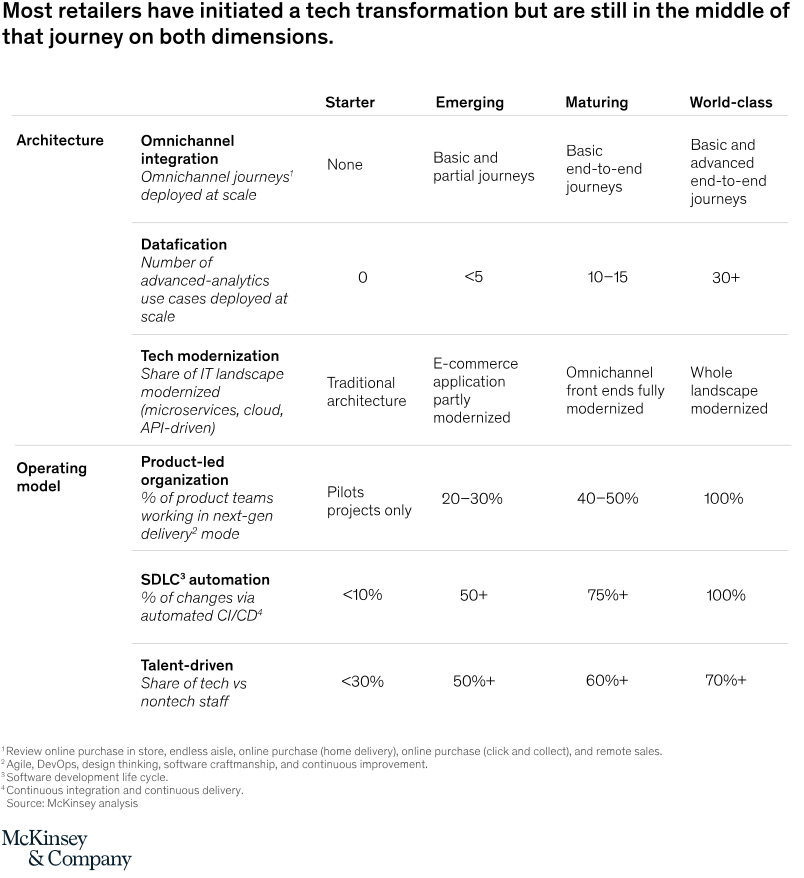
La transformation numérique dans le commerce de détail consiste à intégrer l’avant et l’arrière. L'intégration avancée permettra de créer une feuille de route futuriste de ce qui Entreprises de commerce électronique will need to stay competitive, customer focused and bring in a high level of customer engagement. This will in turn impact their brand positioning, overall sale, geographical reach, revenue growth and brand value in the long run. Backward integration on the other hand would bring in automation, lean processes, faster turn around times, visibility and insights into cost optimization, overall cost and profitability advantages and most of all, agility for the organization. Both of these are important to go hand in hand while planning your transformation numérique stratégie, pour la croissance à long terme et le développement de la marque. Certaines entreprises pensent que la transformation numérique est également un changement culturel au sein d'une organisation qui change leur façon de travailler, la façon dont elles interagissent avec le client et la façon dont elles commercialisent leurs produits, et je crois fermement que c'est le cas. . Ce n’est pas seulement une adoption technologique, c’est une adoption culturelle qui vous prépare pour l’avenir ! Et tôt ou tard, toutes les entreprises de commerce électronique, quel que soit leur secteur, devront rejoindre ce mouvement afin de pérenniser leur marque.
Comme le disait Charles Darwin
“Its not the strongest of the species that survives, nor the most intelligent ones. It is the one that is the MOST adaptable to change”.Wo

 English
  Spanish (Mexico)
  Italian
  French
  German
  Japanese
  Dutch
Dutch  Swedish
  Finnish
  Spanish (Spain)